
Tool Confidence Level
What Is the Tool Confidence Level?
What Is the Tool Confidence Level?
The Tool Confidence Level (TCL) is a ISO 26262-specific metric used to determine the amount of risk originating from a software tool during the development process. Just as a system has a safety integrity level, the TCL defines the "criticality" of a tool. If a tool is determined to be critical, specific measures must be implemented to ensure that it does not negatively impact the safety of the automotive system.
By establishing the TCL, companies can decide if a tool can be used as-is or if it requires a formal qualification process to prove it is safe for its intended purpose.
How Is the Tool Confidence Level Calculated?
How Is the Tool Confidence Level Calculated?
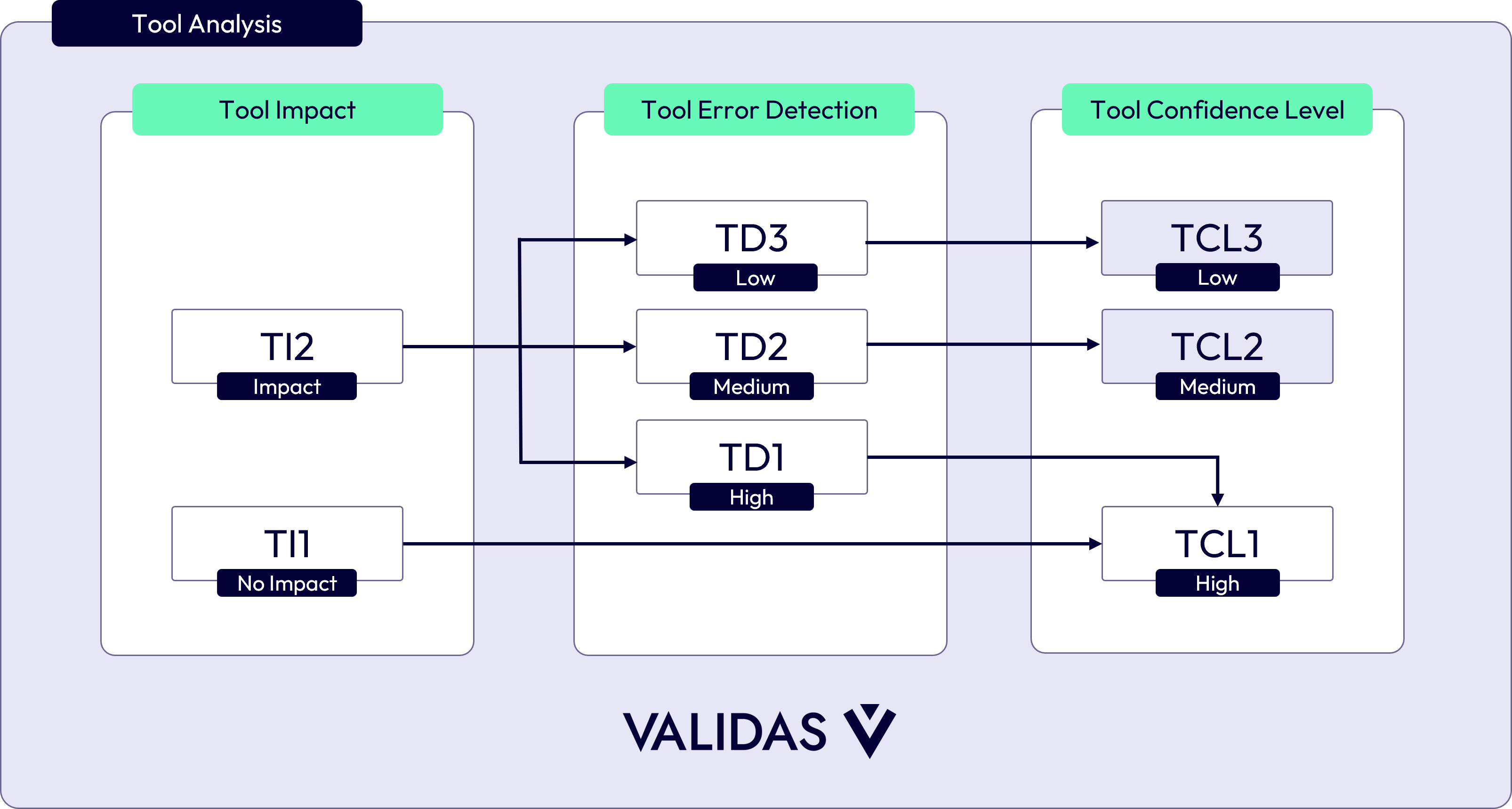
Determining the TCL is a two-step process based on the combination of Tool Impact (TI) and Tool Error Detection (TD).
First, the Tool Impact analysis is performed to see if a tool malfunction can inject an error into the system, such as a compiler creating a faulty executable. If there is an impact, it is rated as TI2. Then, the Tool Error Detection is assessed, which evaluates the probability of catching these errors during tool usage.
The combination of these two factors—impact and likelihood of detection—results in the final TCL rating.
What Are the Differences Between TCL1, TCL2, and TCL3?
What Are the Differences Between TCL1, TCL2, and TCL3?
The three levels of tool confidence indicate the necessity for further safety actions.
TCL1 is the highest confidence level; it means either the tool has no impact on safety or that all potential errors are highly likely to be detected by the user's existing processes. In this case, no formal qualification is required.
TCL2 and TCL3 represent lower levels of confidence where the risk of undetected errors is medium or high. Tools classified as TCL2 or TCL3 must undergo formal qualification methods, as prescribed by ISO 26262, to gain the necessary confidence for use in safety-related projects.
Does Tool Confidence Level Apply Outside of the Automotive Industry?
Does Tool Confidence Level Apply Outside of the Automotive Industry?
While the specific term TCL is central to the automotive standard ISO 26262, the underlying concept is universal across safety-critical industries. In the rail industry under EN 50128, tools are classified into T1, T2, and T3 categories. In the aerospace sector, DO-330 provides a framework for tool qualification that mirrors these concerns. Even in cybersecurity with ISO/SAE 21434 or AI safety frameworks, the goal remains the same: ensuring that the digital instruments used to build a system are not the "weakest link" in the safety chain.
Validas, as a well‑known qualification expert, assists companies worldwide in applying these cross‑industry principles to ensure that, regardless of the sector, software tools and libraries meet the required integrity levels.
Looking to get your tools, libraries, or compilers qualified? We’re here to help. Book a free strategy talk with Dr. Oscar Slotosch.
Dr. Oscar Slotosch
Co-Founder and Executive Board Member of Validas

Does a TCL1 Rating Mean a Tool Can Be Used Without Caution?
Does a TCL1 Rating Mean a Tool Can Be Used Without Caution?
It is a common misconception that a TCL1 classification serves as a "free pass" to use a software tool carelessly. In reality, achieving a Tool Confidence Level of 1 often implies the exact opposite: the user must be extremely vigilant. Because TCL1 is frequently based on a high Tool Error Detection (TD) probability, the safety of the entire system depends on the user’s ability to catch every potential error the tool might make. This is why the Tool Safety Manual (TSM) is so critical for these tools; it must explicitly detail the manual reviews, verification steps, and specific checks the user must perform. If you use a TCL1 tool without strictly following the instructions in its safety manual, you are bypassing the very safety assumptions that allowed for that classification, potentially leaving the system vulnerable to undetected faults.
Stay informed
We’ll occasionally use your email address to share updates on upcoming webinars, events, and the latest news about our products and services.