
Clang
What Is Clang?
What Is Clang?
Clang is an open-source compiler from the LLVM project for C, C++, and Objective-C.
Clang has backends for various processor architectures, including an official backend for ARM microcontrollers and an unofficial backend for Infineon TriCore microcontrollers. Both architectures are widely used in functional safety applications.
In functional safety, Clang is classified as a software tool used in the development of safety-related software.
Due to its potential to introduce systematic faults, its behavior must be assessed in accordance with standards such as ISO 26262 and IEC 61508.
How Does Clang Differ From Other Compilers?
How Does Clang Differ From Other Compilers?
Clang differs from alternatives such as GCC primarily through its modular LLVM-based architecture and its emphasis on detailed diagnostics and tooling integration.
In the first step of compilation, Clang produces an LLVM Intermediate Representation (IR), which serves as a platform-independent code format for further optimization and transformation within the LLVM toolchain.
For safety-related development:
Its diagnostics can support early defect detection.
Its IR-based design allows integration with analysis and verification tools.
Its standards conformance supports predictable handling of defined language constructs.
Further Clang-based and LLVM-based tools, such as llvm-cov, use the same front end for language analysis, ensuring that there are no differences in language interpretation between tools from different vendors.
What Is The Role Of Clang In Functional Safety Development?
What Is The Role Of Clang In Functional Safety Development?
Clang functions as a code generation tool that transforms validated source code into an executable form. According to ISO 26262-8, tools such as Clang must be analyzed for:
Their potential to introduce faults (Tool Impact)
The ability of the development process to detect those faults
Because compiler errors can propagate directly into executable behavior, Clang is typically considered a tool whose malfunction could violate safety requirements.

How Is Clang Assessed Under Functional Safety Standards?
How Is Clang Assessed Under Functional Safety Standards?
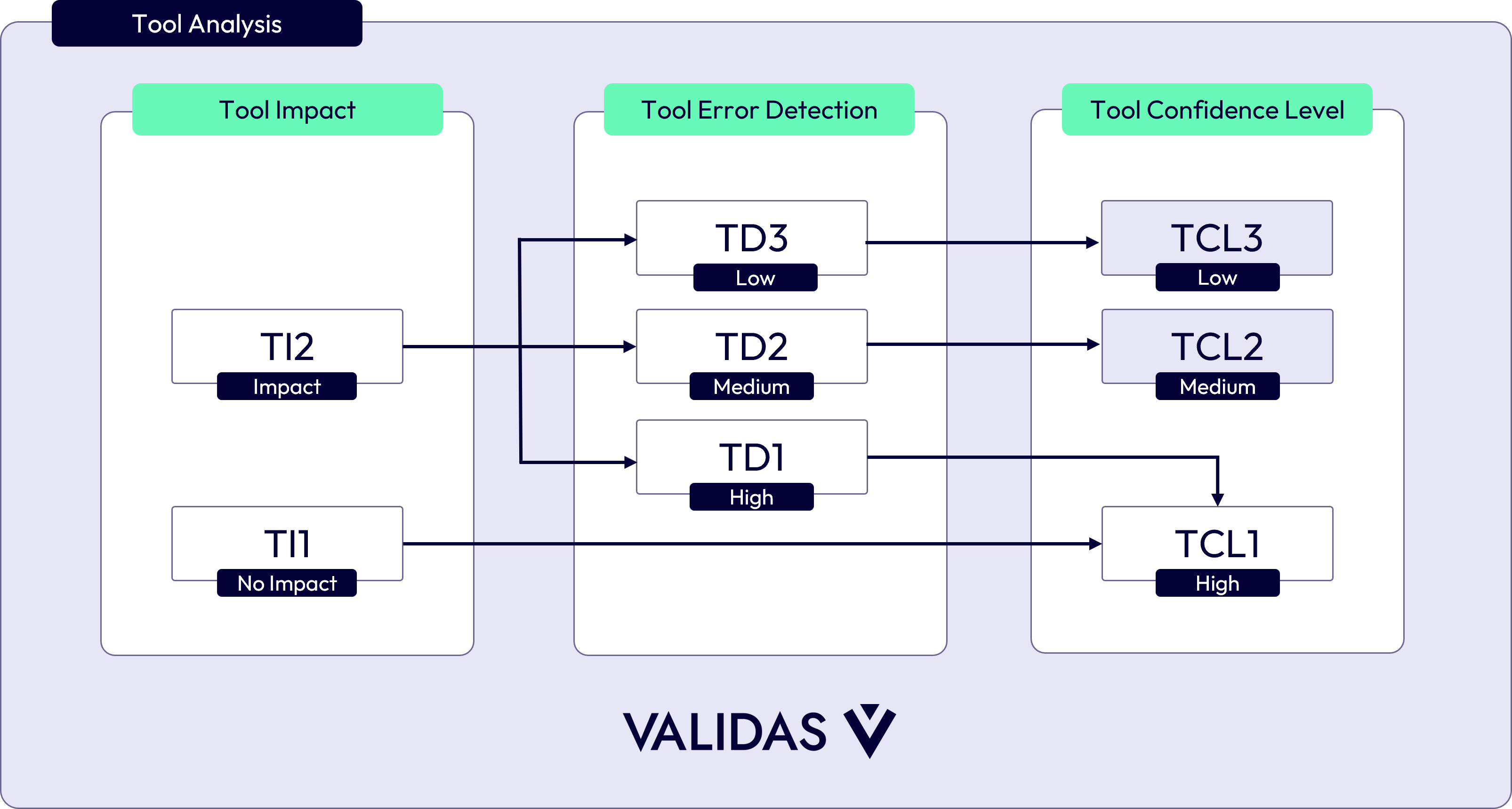
ISO 26262 requires a tool confidence evaluation based on:
Tool Impact (TI)
Tool Error Detection (TD)
This leads to the determination of a Tool Confidence Level (TCL). To achieve sufficient tool confidence, one or more qualification methods may be applied:
1a: Increased confidence from use in accordance with 11.4.7
1b: Evaluation of the tool development process in accordance with 11.4.8
1c: Validation of the software tool in accordance with 11.4.9
1d: Development in accordance with a safety standard.
In practice, Clang is usually qualified via Method 1c by testing and process measures.
References
FAQ
FAQ
No, Clang is not pre-certified; tool qualification or confidence assessment is required. Looking to qualify the Clang compiler? Validas provides a dedicated Clang QKit tailored specifically for that purpose. We offer qualification of Clang according to ISO 26262-8-11.
Not inherently; deterministic builds require controlled configurations and environments.
Stay informed
We’ll occasionally use your email address to share updates on upcoming webinars, events, and the latest news about our products and services.