
ASIL
What Is ASIL?
What Is ASIL?
Automotive Safety Integrity Level (ASIL) is a risk classification system established by the ISO 26262 standard to manage the functional safety of road vehicles.
Rather than representing the safety measures themselves, ASIL identifies the level of risk inherent in a specific automotive hazard. This classification then dictates the necessary safety requirements and the degree of rigor required during the development process to achieve a tolerable level of safety.
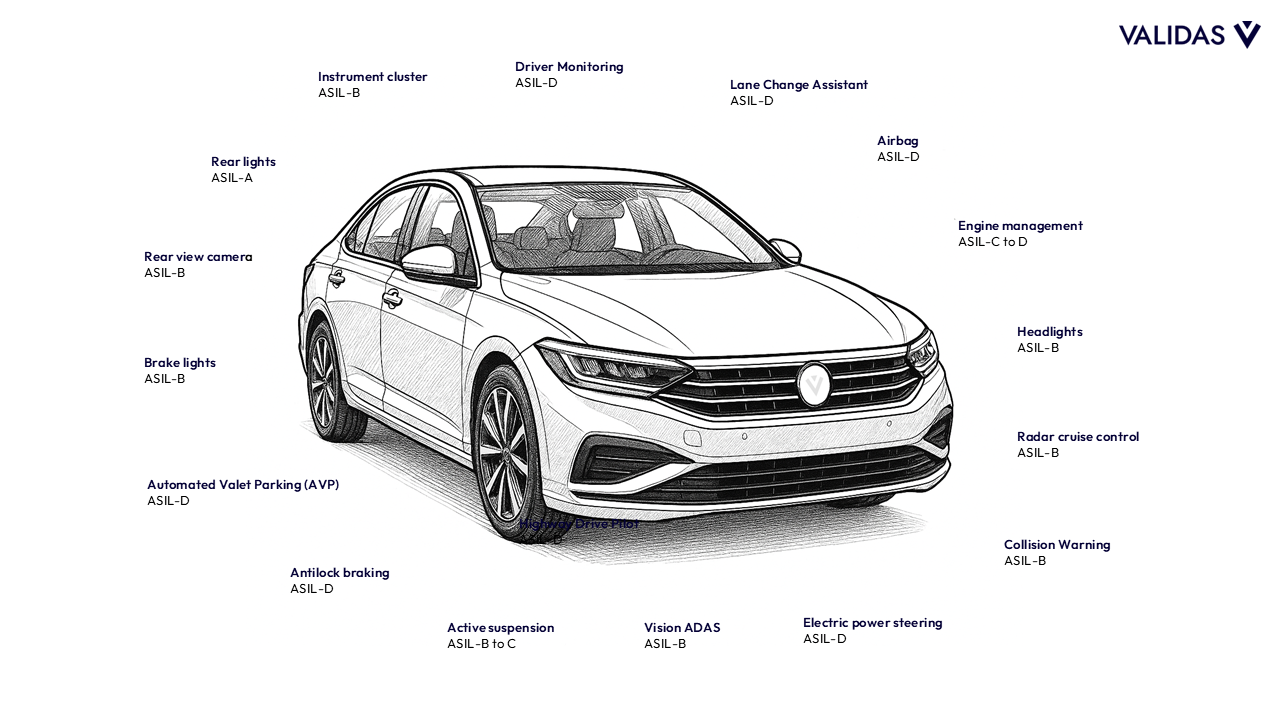
The levels range from ASIL A, representing the lowest degree of hazard, to ASIL D, which represents the highest. Functions that do not carry a specific safety risk are classified as Quality Management (QM).
A QM rating indicates that the hazards associated with that function do not exceed the risks found in normal, non-safety-critical industrial applications. Unlike ASIL-rated components, QM functions do not require the specialized functional safety processes defined in ISO 26262.
How Is an ASIL Level Determined?
How Is an ASIL Level Determined?
The assignment of an ASIL follows a structured Hazard Analysis and Risk Assessment (HARA). During this process, engineers evaluate three critical variables: Severity, Exposure, and Controllability.
Severity measures the potential for physical harm to individuals.
Exposure assesses how frequently a vehicle is in a situation where a specific failure could lead to that harm.
Controllability determines the likelihood that a driver or passenger can take action to avoid the injury once the failure occurs.
By combining these factors, the required integrity level is established for the system's safety, which ensures that the design and testing efforts match the potential danger.
What Are the Differences Between ASIL A and ASIL D?
What Are the Differences Between ASIL A and ASIL D?
The primary distinction between ASIL A and ASIL D is the level of stringency required to prevent hazardous failures. ASIL A is reserved for scenarios where injuries are typically minor and highly controllable by the driver. Because the risk is lower, the requirements for documentation and verification are less intense.
In contrast, ASIL D is applied to high-stakes systems, such as steering or braking, where a malfunction could be life-threatening and difficult to control.
For ASIL D, the ISO 26262 standard mandates the highest level of error-detection and prevention requirements to ensure the system behaves predictably.
Ensure your development process meets the most stringent ISO 26262 requirements without slowing down your innovation.
Dr. Oscar Slotosch
Co-Founder and Executive Board Member of Validas

Stay informed
We’ll occasionally use your email address to share updates on upcoming webinars, events, and the latest news about our products and services.