News
Waymo, Fireworks, and the Limits of Operational Design Domains

Waymo, Fireworks, and the Limits of Operational Design Domains
The first week of July 2026 brought two seemingly unrelated events to San Francisco. Yet together, they highlight one of the most important challenges facing autonomous vehicles today: understanding the limits of their Operational Design Domains (ODDs),
On July 4, during celebrations marking the 250th anniversary of the United States, a large fireworks display triggered severe traffic congestion across parts of San Francisco. Videos quickly spread across social media, with some observers criticizing Waymo vehicles and suggesting they had contributed to the resulting gridlock. Srikanth Seshadri shared a particularly interesting overview of the event, including videos and commentary, in a LinkedIn post.
Only days earlier, Waymo had taken the stage at the Safety.AD USA 2026 conference, where the company presented its approach to defining and managing ODDs. The keynote explained how factors such as road types, speed ranges, weather conditions, times of day, and traffic characteristics are captured in a structured and highly abstract framework. This level of abstraction allows Waymo to reuse ODD definitions and safety concepts across multiple cities and deployment environments, making large-scale autonomous vehicle deployment more practical.
The issue is not that abstraction is flawed. Abstraction is, in fact, essential. Without it, every city, neighborhood, or special event would require a unique ODD definition, dramatically limiting the scalability of autonomous vehicle programs. Abstract ODD models enable organizations to transfer safety concepts and operational logic between locations instead of starting from scratch every time.
However, abstraction comes with an unavoidable trade-off: details are lost. Rare, highly dynamic situations (such as major public events, unexpected crowd behavior, temporary infrastructure changes, or large-scale traffic disruptions) do not always fit neatly into predefined categories.
As a result, a gap can emerge between the theoretical ODD defined during development and the reality encountered on the road.
Defining the ODD is often no longer the hardest safety problem; the greater challenge is identifying, in real time, when actual operating conditions deviate from the ODD and ensuring an appropriate response.
Fortunately, no injuries were reported in connection with the July 4 congestion. Even so, the event provides valuable insights for the broader autonomous driving industry.
ODDs are engineering abstractions designed to describe where and under what conditions a system can operate safely.
The real world, however, has a habit of exposing edge cases, exceptions, and unexpected combinations of events. Every deployment generates new information about the strengths and limitations of existing ODD assumptions. For that reason, ODD management should be viewed as a continuous learning process rather than a one-time engineering exercise.
A clearly defined ODD is a fundamental requirement for compliance with modern autonomous driving standards and regulatory expectations. Yet compliance alone cannot guarantee safe behavior under every possible circumstance.
Real-world environments are inherently unpredictable. Unusual events, rare interactions, and previously unseen traffic situations will continue to challenge even the most advanced autonomous systems. Compliance is necessary, but it is not sufficient.
This lesson extends well beyond ODDs. Standards, audits, and certification processes are essential because they help organizations demonstrate due diligence and systematic engineering practices. Nevertheless, true safety is ultimately measured by how a system behaves when confronted with situations that were not fully anticipated during development.
The most resilient systems are not simply those that satisfy requirements. They are the systems that detect uncertainty, recognize their limitations, and respond conservatively when conditions become unfamiliar.
Organizations with mature safety cultures recognize that compliance and safety are closely related, but not identical.
Compliance asks: Does the system meet the specified requirements?
Safety asks: Does the system continue to behave acceptably when reality exceeds those requirements?
The distinction is subtle but critical. Autonomous driving programs that focus solely on compliance risk overlooking the complex and unpredictable nature of real-world operations.
The most valuable lessons in safety engineering often do not come from accidents. They emerge from unusual events that stress systems, expose assumptions, and reveal limitations while fortunately causing no harm. The San Francisco fireworks congestion may be one of those moments.
More than a discussion about traffic, Waymo, or a single public event, it highlights a fundamental challenge for autonomous driving: not only defining an Operational Design Domain, but continuously justifying why the system remains acceptably safe within and at the boundaries of that domain. This requires more than a documented ODD. It requires a strong safety culture, a convincing safety case, and a practical safety plan that is continuously updated as operational experience grows.
A mature safety case should explain how ODD assumptions are defined, monitored, challenged, and revised. It should also address how the system detects uncertainty, recognizes situations that may exceed its intended operating conditions, and responds conservatively when the real world no longer matches the assumptions made during development. In this sense, ODD management is not only a technical task; it is part of the broader safety argument.
At Validas, we support organizations in structuring safety cases, safety plans, tool qualification arguments, and compliance evidence for safety-critical software and autonomous systems. If you are working on ODDs, AI-based functions, safety-critical toolchains, or software compliance, we would be happy to discuss how Validas can help turn operational assumptions into clear, auditable, and maintainable safety arguments.

 Deep Dive
China Makes ISO 26262 Mandatory for L2 Vehicles: A New Era for Automotive Safety and Cybersecurity
Deep Dive
China Makes ISO 26262 Mandatory for L2 Vehicles: A New Era for Automotive Safety and Cybersecurity
 News
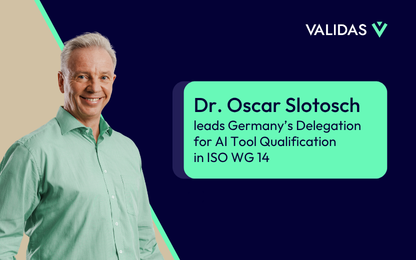
Oscar Slotosch Leads Germany’s Delegation for AI Tool Qualification in ISO Working Group 14
News
Oscar Slotosch Leads Germany’s Delegation for AI Tool Qualification in ISO Working Group 14
 Beginner's Guide
EU Cyber Resilience Act (CRA): What Tool Providers Really Need to Know
Beginner's Guide
EU Cyber Resilience Act (CRA): What Tool Providers Really Need to Know