Deep Dive
The Tool Safety Manual: A Lifesaving Resource

The Tool Safety Manual: A Lifesaving Resource
Across the critical terrain of safety-critical systems from advanced automotive features to robots and industrial automation, every detail counts. Yet, there’s one document that often goes unnoticed by developers and safety managers: the Tool Safety Manual (TSM).
This manual is more than a tick in the compliance box. It’s your hands-on guide, your safeguard, and a non-negotiable requirement for ensuring the integrity of your safety-related work.
We all know user manuals explain installation, navigation, and features. A Tool Safety Manual is different. It focuses on how to use the tool safely in a safety-critical context.
Think of it as a set of building blocks for safe usage, not a feature list. For example, a TSM might:
Prohibit risky features that could compromise safety.
Mandate review steps after certain tool operations.
Restrict input types to ensure safe processing.
A TSM serves two essential roles:
Guidance
Clear, actionable instructions for using the tool without jeopardizing safety integrity.
Protection
It condenses complex safety documentation like Tool Classification Reports or Tool Qualification Reports into practical rules for everyday use.
Without a TSM, developers risk misusing tools in ways that could lead to system failures, compliance breaches, or even safety hazards. In regulated industries, this document is not optional, but a cornerstone of functional safety.
Bottom Line: The Tool Safety Manual bridges the gap between compliance and practical safety. It empowers teams to work confidently, knowing they’re aligned with safety standards. Furthermore, grounded in ISO 26262 (see clause 8-11.4.3), the Tool Safety Manual is not optional, it’s a regulatory necessity for compliance.
In the ecosystem of tool safety documentation, there are multiple reports—classification analyses, qualification evidence, and detailed assessments. These documents are essential for safety managers, as they provide the foundation for proving that a tool is fit for use in a safety-critical environment.
But here’s the key distinction:
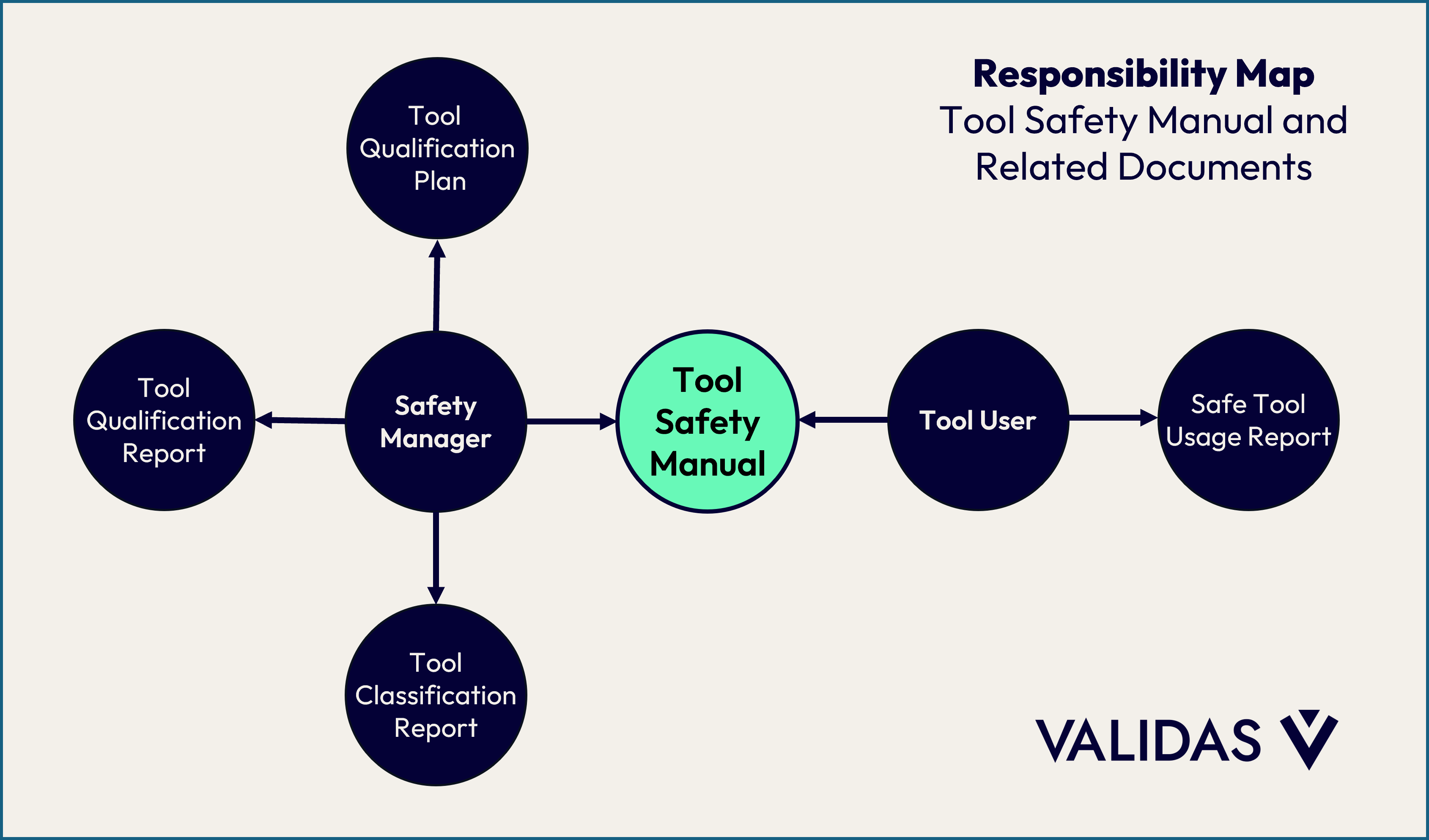
For the individual developer, i.e., the one writing code, running tests, or using modeling tools, the Tool Safety Manual (TSM) is the only document that directly dictates their actions. From the tool user’s perspective, it’s the single source of truth for safe tool usage.
Why This Matters
You don’t need to read through a full qualification report every time you use a compiler or modeling tool. What you need to do is to strictly follow the guidelines in the Tool Safety Manual. These measures are not just best practices; they are the concrete application of compliance requirements for tool evaluation and qualification.
In Short:
Safety Managers → Use detailed reports for compliance evidence.
Tool Users → Follow the Tool Safety Manual for day-to-day safe usage.
Bottom Line: The TSM translates complex compliance into actionable steps for developers. It’s not optional, it is your mandate for maintaining safety integrity.
When it comes to ISO 26262 and tool classification, the Tool Safety Manual (TSM) often doesn’t get the attention it deserves. Yet its content is directly shaped by the tool’s safety evaluation, specifically, how it’s classified and, if needed, qualified.
This evaluation hinges on two key factors:
Tool Impact (TI) – Does the tool influence safety-related outputs?
Tool Detection (TD) – How easily can errors be detected?
Together, these define the Tool Confidence Level (TCL), which determines qualification needs and the role of the TSM.
TI1 (No Safety Impact)
If a tool has no safety impact, it falls into TCL1. No qualification is required and typically, no TSM is needed.
TI2 (Safety Impact)
If a tool can affect safety, things change:
TD1 (High Detectability) → Still TCL1, but now a TSM becomes essential. Why? Because it tells users how to detect errors or avoid unsafe use through reviews, checks, or mitigation steps.
TD2 or TD3 (Low Detectability) → The tool moves to TCL2 or TCL3, requiring qualification. Here, the TSM plays a lighter role, focusing on validated versions, supported configurations, and known limitations.
Key Insight: Tool qualification reduces the burden on the user, but it doesn’t eliminate the need for a TSM. The manual remains a critical deliverable, bridging the gap between tool development and safe tool usage in functional safety projects.
Bottom Line: The TSM is not a formality but a practical reflection of the tool’s evaluation and your roadmap for safe usage.
A Tool Safety Manual (TSM) is a practical guide for safe tool usage. Here’s what you’ll typically find inside:
1. Allowed Configurations
Specifies the exact versions of the tool, operating system, libraries, and other environmental factors that have been assessed for safe use.
2. Usage Restrictions
Lists features or inputs that are forbidden or restricted in safety-critical applications.
3. Required Mitigations
Details the actions that the user must take to detect or avoid potential errors such as review processes, verification steps, output comparisons or using complementary tools.
4. Known Bugs and Anomalies
If applicable, includes identified issues that could impact safety and provides clear instructions for handling or working around them.
Clarity is critical. A TSM should never say “check for compiler optimization errors” without explaining how to do it. A good manual suggests concrete steps like running functional tests or achieving specific code coverage levels to verify the tool’s output.
Ambiguity in a safety document is a direct pathway to risk.
While developers follow the TSM, the safety manager ensures compliance. This means:
Distributing the TSM and requiring acknowledgment (e.g., sign-off).
Documenting safe tool usage during development.
Automating enforcement in continuous-integration environments, checking configurations and mitigations automatically.
Documenting Safe Usage: The Safe Tool Usage Report
The TSM tells you how to use the tool safely. The Safe Tool Usage Report proves that you did use it safely.
Example: If the TSM requires reviewing generated code, you must document that review for every instance (eg: Module A, Module B, Module C) of the software module that you used the generator for. This evidence is vital for audits and safety cases.
To reduce manual effort, companies increasingly automate report generation, making compliance efficient and traceable.
Bottom Line: The TSM and Safe Tool Usage Report work hand-in-hand. While one defines safe usage, the other proves it.
Validas' advanced model-based approach to generating safety documents stems from a deep analysis of tool features, potential errors, inputs, and outputs. By systematically documenting this "error model," using our in-house Tool Chain Analyzer (TCA), we can automatically generate Tool Safety Manuals that are precise, comprehensive (covering necessary mitigations), and yet as concise as possible (thanks to the rigor of qualification).
We believe that clear, concise, and accurate Tool Safety Manuals are fundamental to building safe systems efficiently. They bridge the gap between high-level safety requirements and the daily work of the development team.
The Bottom Line
The Tool Safety Manual is not just a peripheral requirement in tool classification and, if applicable, qualification is a central, essential part of the process. It serves as the practical, user-facing embodiment of all the safety considerations behind the tool. This document directly empowers developers to use complex tools safely and correctly within regulated environments.
Understanding its purpose, adhering strictly to its contents, and having clear processes (and ideally, automated tools) for documenting its usage are essential for compliance, risk reduction, and ultimately, for building trustworthy safety-critical systems. Don't overlook the quiet guardian – your safety depends on it.
Don’t Let the Tool Safety Manual Be Your Blind Spot!
Join Oscar Slotosch in our dedicated podcast episode as he breaks down what makes a Tool Safety Manual effective and why it matters for functional safety.
If you’re ready to go deeper schedule a free consultation and we will review your case and help you understand what's needed.